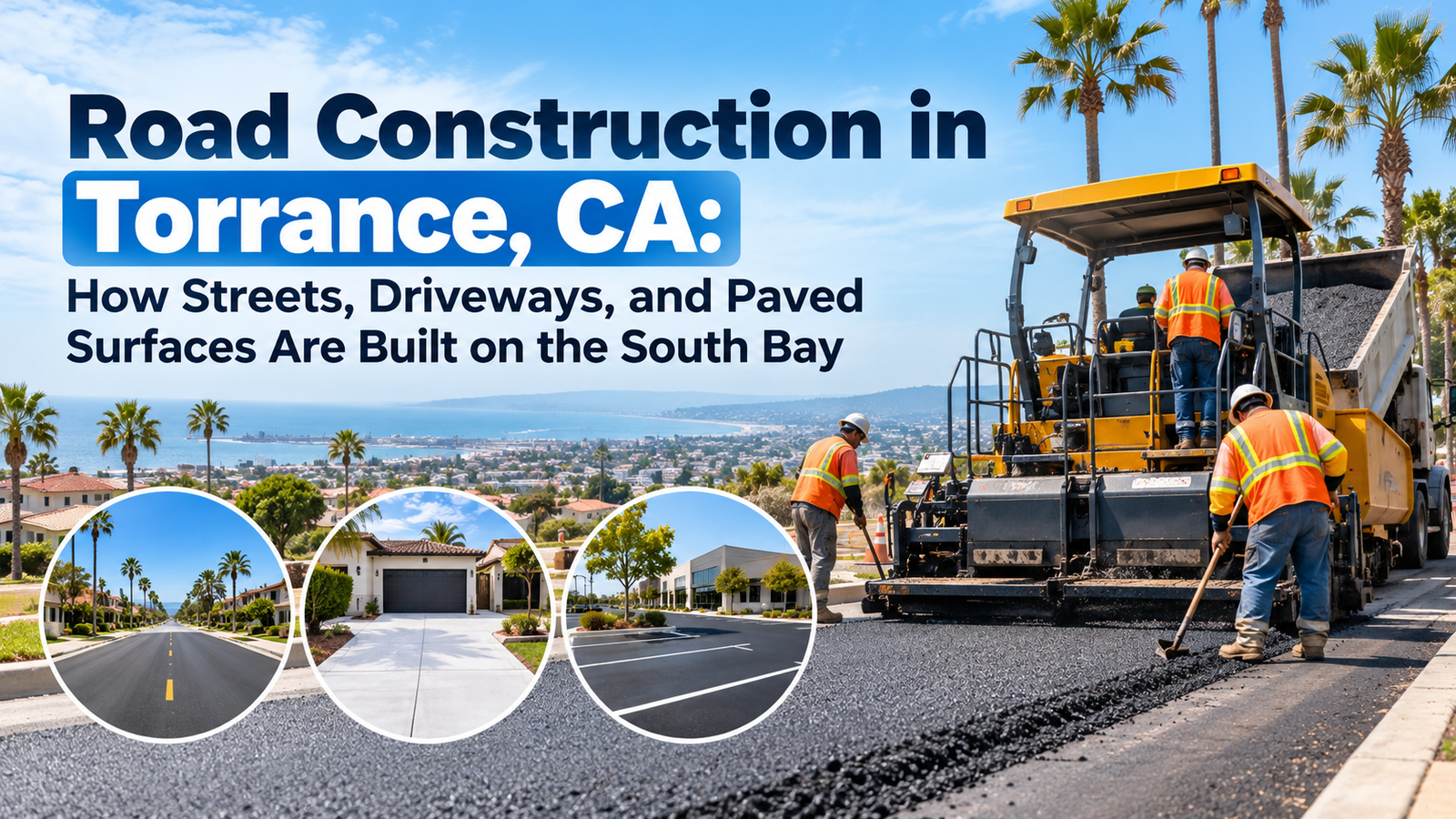
Torrance is one of Los Angeles County’s most significant suburban cities a well-planned, mid-century industrial and residential community in the South Bay that has matured into a densely built environment where Road Construction Company Torrance and pavement infrastructure underpin nearly everything that moves. From the arterial grid of Torrance Boulevard, Hawthorne Boulevard, and PCH to the residential streets and private driveways that serve the city’s neighborhoods, the constructed road surface is the physical foundation of how people and goods move through this community every day.
Road construction is a broad field that encompasses everything from the grading and base preparation that precedes paving to the asphalt and concrete surface installation that creates the finished driving surface. Understanding what road construction involves the materials used, the standards applied, the local regulatory context gives property owners, facility managers, and community stakeholders the background to understand what is happening when road and pavement work takes place in Torrance.
What Road Construction Actually Involves
The term “road construction” covers a spectrum of work that ranges from building a new roadway from raw ground to resurfacing an existing paved street. At the most comprehensive end, new road construction begins with site preparation: surveying and staking the alignment, clearing vegetation and debris, grading the subgrade to establish the proper cross-section and drainage slopes, and compacting the native soil to the density specified by the project’s geotechnical investigation. California’s Department of Transportation (Caltrans) and Los Angeles County’s Public Works Department both publish standard specifications that govern grading, compaction, and base materials for roadway construction on public rights-of-way.
Below every properly built road is a structural section: layers of engineered material that distribute the loads from vehicles across the subgrade soil. Aggregate base crushed stone compacted to specific density and gradation standards is the primary structural layer under asphalt roadways. The thickness of the structural section is determined by traffic loading analysis (the expected vehicle weights and volumes), the supporting strength of the subgrade soil, and the design life of the road. A lightly-traveled residential street has a much thinner structural section than a commercial arterial carrying delivery trucks and buses.
The surface course the asphalt or concrete layer that vehicles actually drive on is the most visible component of road construction but represents only the top fraction of the total structural section. Hot mix asphalt (HMA) is the dominant surface material for most road construction in Torrance and the broader Los Angeles Basin: it is placed by paving machine and compacted by roller equipment while still hot, forming a continuous, smooth surface. Concrete is used for some high-wear applications and portions of the road network where its rigidity is advantageous.
Torrance’s Road Network and Urban Context
Torrance’s street network reflects its planned development history. The city was laid out and developed rapidly in the mid-twentieth century, and its grid of arterials separated from residential streets by a hierarchy of collector roads creates the organized street pattern that characterizes Torrance compared to some of the more organically developed communities around it. This planned character also means that much of the street infrastructure was installed within a relatively narrow time window, which has created a pattern where many streets are aging at similar rates and require maintenance and reconstruction on a broadly synchronized schedule.
The 310 and 424 area codes of the South Bay reflect a region that is intensely developed Torrance is bordered by Redondo Beach, Lawndale, Gardena, Carson, Lomita, and Rancho Palos Verdes, all equally built out. This density means that road construction in Torrance must navigate utility conflicts carefully: the subsurface beneath Torrance streets contains an extensive network of water mains, sewer lines, storm drains, gas mains, electrical conduits, and telecommunications infrastructure, and any roadway excavation or reconstruction must be coordinated to avoid or manage conflicts with buried utilities.
The Los Angeles Basin’s climate creates a relatively benign environment for road infrastructure compared to freeze-thaw climates in other parts of the country. The primary distress mechanisms for asphalt pavement in the South Bay are UV oxidation (which dries and hardens the asphalt binder), traffic-related fatigue cracking, and reflective cracking from underlying base or subgrade movement. Freeze-thaw damage the primary failure mechanism in northern climates is essentially absent in Torrance’s mild winters.
Pavement Engineering for the Los Angeles Basin
Asphalt pavement design in Los Angeles County uses the California pavement design procedure, which incorporates regional climate factors, traffic loading analysis, and soil support values specific to the project location. Caltrans maintains the Highway Design Manual and the Standard Specifications for Public Works Construction (the “Greenbook”), which govern materials and methods for road construction throughout the state. Los Angeles County Public Works publishes Standard Plans and Standard Specifications that supplement Caltrans standards for county roads and those cities that adopt them.
The South Bay’s soil conditions vary significantly across short distances. Torrance sits on Quaternary alluvial deposits from the Dominguez Channel and Torrance Creek drainages, and the soil profile ranges from sandy loams with good bearing capacity in some areas to heavier clay-bearing soils in others. Expansive clays soils that swell and shrink with moisture changes can cause pavement distress through subgrade heave and differential settlement. Geotechnical investigation, including soil borings and laboratory testing, provides the soil support values that drive structural section design.
Drainage is one of the most critical factors in pavement longevity, and Torrance’s relatively flat topography creates drainage design challenges. Water that ponds at the pavement edge or infiltrates through cracks accelerates pavement degradation by softening the base and subgrade. Good road construction includes attention to shoulder grades, inlet placement, and subdrainage where needed to keep the structural section dry.
Public vs. Private Road Construction in Torrance
Road construction in Torrance takes place in two distinct regulatory environments depending on whether the work is on public right-of-way or private property. Work on public streets including city streets, county roads, and state highways within Torrance is governed by the City of Torrance’s public works permit requirements, which mandate encroachment permits, traffic control plans, and inspection by city inspectors. The standards that apply are the Greenbook and Caltrans Standard Plans.
Private road construction driveways, parking lots, private roads in industrial or commercial complexes, and site roads on private property is governed by the City of Torrance’s building permit process and the standards of the California Building Code as adopted by the city. While the fundamental engineering principles are the same, the permit process and inspection regime are different from public road construction.
Torrance’s industrial concentration the city hosts a significant base of manufacturing, aerospace, and distribution operations, including operations associated with the former Torrance Refinery site creates a robust private road construction market in the commercial and industrial zones. Industrial facilities with heavy truck traffic have more demanding pavement structural requirements than standard commercial or residential applications, and road construction for these clients requires careful attention to axle loading in the structural section design.
Road Construction Materials and Their Performance
Hot mix asphalt is the material used for the vast majority of road construction in Torrance and throughout Southern California. Modern HMA mixes are designed using the Superpave mix design system, which optimizes the gradation and binder content to balance rutting resistance, fatigue cracking resistance, and workability during placement. The binder grade selected for a given project depends on the climate (performance grade selection based on the pavement temperature range expected at the site) and traffic loading.
Recycled asphalt pavement (RAP) is widely incorporated into new asphalt mixes in California. Using RAP reduces the amount of virgin aggregate and asphalt binder needed and provides a sustainable use for the material milled from roads during rehabilitation. California’s quality specifications for RAP content in new mixes ensure that the recycled material meets performance standards. Locally, the Los Angeles Basin has well-developed recycling infrastructure for construction materials.
Portland cement concrete is used for specific road construction applications in Torrance intersection corners and crosswalks, gutters and curbs, and some high-traffic sections where concrete’s rigidity and durability advantages over asphalt are worth the higher initial cost. Concrete also requires less frequent maintenance than asphalt for heavily loaded applications, which can make it economical over a long project life.
Frequently Asked Questions: Road Construction in Torrance, CA
What permits are required for road construction in Torrance?
Work on public streets and rights-of-way in Torrance requires an encroachment permit from the City of Torrance Public Works Department. Encroachment permits require a traffic control plan, contractor insurance, and compliance with Caltrans and Greenbook standards. Road construction on private property requires a building permit from the Torrance Building and Safety Division. Projects that disturb more than one acre of soil also require a Construction General Permit under the State Water Resources Control Board’s NPDES program, which mandates a Stormwater Pollution Prevention Plan (SWPPP).
Why is the structural section below the asphalt surface so important?
The structural section the aggregate base and subbase layers beneath the asphalt surface is what distributes vehicle loads from the surface down to the native soil. Without an adequate structural section, even the best asphalt surface will fail prematurely as the loads punch through to the soft subgrade. In the Los Angeles Basin, where many soils include expansive clays that weaken when wet, a well-designed and well-compacted structural section is essential for pavement durability. The structural section thickness is determined by traffic loading and soil strength through the California pavement design procedure.
What causes roads to crack and fail in the South Bay?
In Torrance and the South Bay, the primary road failure mechanisms are fatigue cracking from repeated traffic loading, UV oxidation that hardens and brittles the asphalt binder over time, reflective cracking from movement in underlying layers, and subgrade distress in areas with expansive or weak soils. The South Bay does not experience freeze-thaw damage, which is the dominant failure mechanism in colder climates. Drainage deficiencies water infiltrating through pavement cracks and softening the base accelerate all of these failure mechanisms significantly.
What is the Greenbook and why does it matter for Torrance road construction?
The Standard Specifications for Public Works Construction, commonly called the “Greenbook,” is the standard specification document used for public works construction throughout much of California, including Los Angeles County and the City of Torrance. It specifies materials, testing requirements, and construction methods for road construction, utility work, and other public infrastructure. Contractors working on Torrance public streets must comply with the Greenbook’s requirements, and projects are inspected by city public works inspectors to verify compliance.